I’ve got a hard truth for you: if your brand can’t handle diverse creative content, you need to revisit if paid media is the right channel for you.
The game has changed in terms of how Meta targets and delivers ads. It’s no longer just about demographics and interest-based audiences. Instead, the creative itself has become the targeting mechanism.
So brands who aren't thinking strategically about their creative are leaving serious performance on the table.
I’m Alayna Moxness 👋, Creative Lead at Vervaunt. In this article, I’ll walk you through exactly how I build a creative strategy for paid social from start to finish, so you can keep up with the creative diversity that Meta needs to get your brand in front of the right audiences.
Why so many brands struggle with creative diversity
Creative diversity can still feel like your brand, but with different outfits on. The problem is most brands haven't got there yet.
The issue isn't simply producing more content, it's building a strategy that connects with the right audience at the right time, at every stage of the funnel. And the main thing holding brands back is too much brand protection. If your brand guidelines don't leave room for commercialisation within paid creative, you will miss opportunities on paid media channels.
Meta's Andromeda update makes this non-negotiable. Rather than relying on demographic and interest-based audience targeting, the algorithm now uses the creative itself as the targeting mechanism — meaning the content you put out determines who sees it.
Creative assets that look too similar are punished. You need campaign imagery with different actions and poses, multi-product, face images, no-face images, product-only, flatlays, layouts, text only, video, BTS, storytelling, lifestyle, product quality, animations, and more.
Let your brand be alive and malleable in your paid channels. The fix comes down to three things:
- Understand your audience first. Without a clear picture of who you're speaking to, every other decision is a guess.
- Believe in storytelling to a specific audience. Generic messaging doesn't connect — the story needs to be relevant to the person you've built a persona around.
- Flex your brand's versatility. Creative diversity can all feel like your brand, but with different outfits on. If your brand can't handle that level of flexibility, it's worth revisiting whether paid media is the right channel for it.
How to build a creative strategy for paid social
So, how do you build a creative strategy for paid social, whilst trying to keep on top of the creative demands of the platform? Here’s what we do at Vervaunt.
1. Start by getting to know the brand
The first step is really getting to know the brand we’re working with. After reviewing the website and social media and having brand discovery calls, we can start the analysis.
We approach analysis in two ways: competition and brand-specific. We look at the positioning of the brand within the market to start informing the differentiation points and better understand the audience. We look at trending ad styles and brands who are doing it best.
If you’re doing this in-house, this might mean taking a look at your competitors in the Meta ad library. And auditing the content you already have in the wild.
2. Identify your content gaps
From there, we look at what has been running through the funnel and where the gaps are. We've developed an asset diversity category list to determine where there are content opportunities and which funnel stages need more attention. This includes three main categories: Campaign, E-Comm, and Storytelling — and each of those has a huge list of subgroups.
Here’s a simplified version, taken from my slides at Pulse Ecommerce, Vervaunt’s annual conference designed for ambitious high-growth retailers and brands.
.avif)
Typically brands are either really good at lower funnel or really good at upper funnel — and they ignore the other, which causes missed opportunities in paid performance.
3. Build your audience personas
After the initial assessment, we go into a Persona Building Workshop. This is where we dive into the psychographic, behavioural, and purchase-specific details about the audience. Demographics can be included, but they're certainly not the most important piece. The goal is to really paint a picture of who the audience is.
The most important thing to remember here: this is the life of the person without your brand. To relate to your customer, you need to know who they are before you’re in the picture. Purchase trigger and price sensitivity are also key details to nail down at this stage.
Here’s an example of an audience persona. The details in the green box are the purchase trigger and price sensitivity.
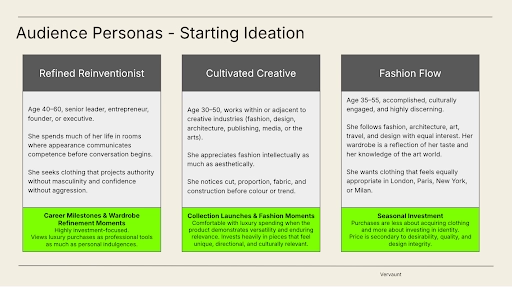
The reason this step matters so much right now is Meta's Andromeda update. All ad delivery is now based on creative-based targeting. So if your creative isn't accurately speaking to the audience you want to reach, it won't actually reach them.
Tip: Poll your team to see if they can guess which statics are for each audience to make sure the targeting is right.
4. Build creative collections for each persona and funnel stage
Once you have your personas, you take the messaging priorities, product categories, and specific products and build creative collections targeted at the specific persona, at the specific point in the funnel.
These are the most important considerations for each stage:
Top of funnel: This is not about your brand. It's about the audience and what they want to see. Is it aspirational? Is it eye-catching? Is it funny? Is it intriguing? Do they want to look like that? Is it something they want to learn more about? Rule number one: if you're going to talk about yourself, treat it like an introduction, not a sell.
Le Chameau provides a great example of an aspirational Meta ad, whilst offering an introduction to the brand.
Middle of funnel: Tell a story the audience can connect to. Bring together who the audience wants to be — or what they need — with your brand's story. Add detail, fill in the blanks, educate, and show off the specifics. This is where true differentiation comes in.
Strathberry has a super-satisfying ASMR style video showing a close up of two of their handbags, with someone demonstrating how many items can fit into them. This is worth watching with the sound on (head over to the Meta Ad library).
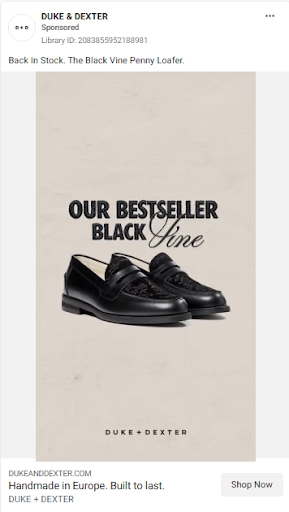
Bottom of funnel: This is the ask, so be direct. Tell them what makes right now the right time to buy. That could mean an event, a sale, a new drop, the right investment piece for a season change, a restock. There are lots of options — don't default to a sale every time.
In the case of the Duke + Dexter, they use this opportunity to prompt their audience that one of their bestsellers is back in stock.
The format and message will look different at each stage — but the through line is always storytelling. Top, middle, or bottom of funnel, every piece of creative should be telling a story that's relevant to that specific audience.
5. Use a creative matrix to map your content
From there, we work on a creative matrix framework to make sure we have enough content through the funnel, that it's different enough, and that it will target the right audience.
6. Create, test, and iterate
Don't rush the content creation phase. Do a lot of testing and make sure you're reporting on metrics that actually matter through the funnel.
Then iterate. Revisit the initial foundations of the strategy and continue to build on top of your learnings.
How to measure creative performance
Creative performance tracking needs to be done with the specific funnel phase at the core.
- Top of funnel should be measured by reach and CPM (cost per thousand impressions), thumb stop ratio, and hold rate. Are people spending time watching the content? Is it stopping the scroll?
- Middle of funnel should be measured by CTR (click-through rate), add to cart, reach and CPM, and thumb stop ratio and hold rate. Are people wanting to learn more?
- Bottom of funnel you're looking at CTR, purchases, and ROAS (return on ad spend). ROAS can be a deceiving metric though, so always check purchases and spend alongside it, and establish what a good ROAS benchmark looks like for your specific business.
Beyond the funnel metrics, it's also worth looking at creative lifespan. Consider: does it still perform over time as frequency and fatigue increase? And compare winners against underperformers to pull out insights based on what's connecting with your audience and what isn't.
At Vervaunt, we've built a tool called Abacus to aggregate the same creative regardless of which ad set it's built into, organise it by geographic market, and tell you the performance across the specific creative. That saves a lot of time in reporting.
From there, collect your winners to feed into future creative decisions. The messaging that worked can be iterated on, colours that connected can be incorporated, and the story can continue to be told with what's already working.
Where to start this week
If you're just starting to think more strategically about your creative, here's what to do:
Look at brands doing diversity really well for inspiration. I’ve already mentioned a few, but my favourites are — ME+EM, YSL, Jacquemus, Le Chameau, Strathberry, Duke + Dexter. Look at the range of creative and ad-types they’re pushing in the Meta Ad Library.
Then put together your three core audience personas. Give them names and make them real characters in your mind. Gather the assets you already have and put together two static ads for each audience that speak specifically to them — middle of funnel is the best place to start.
From there, you can start real testing and build internal buy-in for the change.
Want help building a creative strategy that performs?
Vervaunt works with eCommerce brands to build paid social creative strategies that drive real performance — from audience research through to testing and iteration. Feel free to get in touch with us on our website, or follow me on LinkedIn.
Plus, if you need a place to store, organise and deploy all your creative assets, look no further than Dash.
👉 Check out Dash’s digital asset management solution.

Alayna Moxness is Creative Lead at Vervaunt, a London-based e-commerce agency specialising in paid media for fashion, lifestyle, home, and beauty brands. Before moving agency-side, she spent her career in high-growth startups and technology companies, including leading marketing through a NASDAQ listing. Drawing on experience across brand, design, and performance marketing, Alayna helps businesses create growth strategies that are both commercially effective and creatively distinctive.