In January 2026, we helped Seep create a single Meta video ad that drove £100K worth of spend.
At the time of writing, it has 8.7 million views and 5,000 individual purchases.
This isn’t the only video ad that’s had this level of success. We have a number of these across the brands we worked with. And most of them follow a similar format.
I’m Simon Freeman, Founder of Welcome To Digital. In this article, I’ll share the formula behind Seep’s winning Meta, what hook gets the most eyeballs, how to brief creators and how to keep track of your creative.
A teardown of Seep's best-performing Meta ad
Any single ad you can push more than £100k through has proven it's truly scalable. This Seep ad has been running for 10 months and continues to perform consistently month on month. Here’s why it worked:
The format
First, the format is a compilation edit. We collected the best bits of the month's video content, bundled into one snappy, fast-paced ad that hits every proof point.
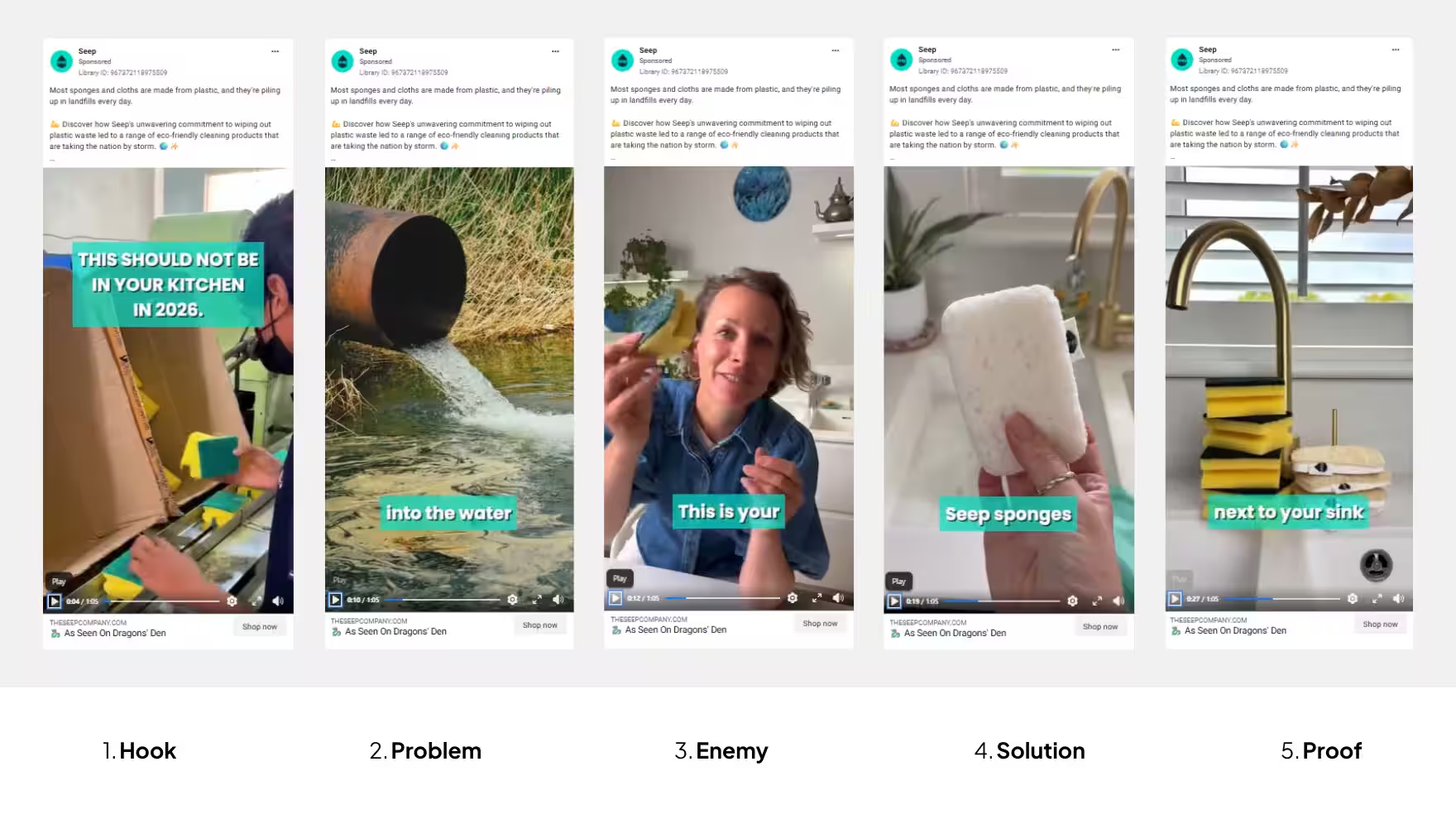
The structure
1. Hook: The visual hook is an instantly recognisable item most households use - the dish sponge. The voiceover calls it out as the item “everyone is saying goodbye to in 2026.” At this point, it’s not about Seep’s product. Instead, it's about the viewer's world, and it piques enough interest that they want to know why they shouldn't be using it.
2. Problem: Next, we make the familiar item feel bad. The sponge sheds microplastics that wash down the sink and into our water and oceans. The ad escalates from the viewer’s kitchen to the whole planet, and the feeling we want to leave them with is concern.
3. Enemy: The sponge is held up and demonised one more time to reinforce the point.
4. Solution: The product enters as the answer to a problem the viewer now knows they have, positioned strongly against the enemy.
5. Proof: The viewer needs to know the product works as well as the sponge, so we answer their objections up front. The easiest way to find those objections is in the questions people ask on your social posts. For Seep, the two big ones were whether it scrubs well and whether lots of people have already bought it.
6. CTA: The call to action has to be earned before anyone will act on it. Ours is “Five minutes to make a small switch, but make a big difference.” It makes acting feel easy and the payoff feels big.
Keeping things simple
Another key point is we don't overcomplicate the messaging or the CTA, and the product page reinforces the ad's messaging. It sounds simple because it is — but you'd be surprised how often these things are missed.
The results
So how well did it do? Here are the results 🙌
12 tips for creating a Meta video ad that drives sales
So you’ve seen how simple it can be to create a winning ad for Meta. Here are my tips for you to start planning your next video.
1. Make it feel native
One thing I always remind brands is that 99% of people don’t go on social media to look at ads. They go there to be entertained, educated and inspired. That’s why being native to the platform should always be your first priority.
In practice, that means using native formats. It might mean dropping your logo or brand name so they aren’t the focus. It also means having people talk to the camera instead of using a voiceover, and styling your captions like organic content.
2. Build it on a proven structure
There are lots of proven structures you can use for video content and copywriting, including:
- AIDA (attention, interest, desire, action): grab attention, build interest, create desire for the product, then ask the viewer to act.
- PAS (problem, agitate, solution): name a problem, make it feel more urgent, then present your product as the fix.
- BAB (before, after, bridge): show life before the product, paint a picture of life after it, then show how the product gets them there.
- FAB (features, advantages, benefits): explain what the product has, what that lets it do, and why that matters to the viewer.
The list goes on. Different structures work in different scenarios and for different audiences. What matters is that they’re proven, so building your ad on one gives it a better chance of success.
3. Don’t overcomplicate it
Keeping things simple is incredibly important. We don’t overcomplicate the messaging or the call to action, and the product page backs up what the ad says. It sounds simple because it is, but you’d be surprised how often brands miss it.
4. Hook with what they see and what they hear
Remember that a hook has two parts: what the viewer sees and what they hear. If you only focus on one, you’ve done half the job. People see a huge amount of content every day, so your hook has to earn the right to be watched.
Plus, impact is key. Visually, open on something instantly recognisable, or something that shocks or entertains.
5. Put your founder in front of the camera
For most challenger brands, particularly in food, health and wellness, founder-led content is the way forward. It's how you create lifelong customers who are loyal to your brand and advocate for it.
Have your founder talk about the problem they set out to solve and why it matters to them and to society. Show the hard work behind the solution and the thought that went into the product's design or makeup.
It also builds a different kind of customer. Someone who buys once off a discount is very different from someone who's seen a founder speak directly to their beliefs. They buy into the brand and what it stands for.
It's daunting for a lot of founders to be on camera. But a good editing team can make any founder look fantastic.
6. Mix in creator content for variety
Having said that, there's absolutely still a place for UGC (user-generated content). Some people will relate to a creator more than a founder.
Variety is what helps accounts grow and scale. Meta's ad retrieval system picks from the pool of ads you give it, so truly different creative gives it a better chance of matching the right person to the right ad. (Still, an authentic founder can pull on the heartstrings better than any UGC creator.)
7. Brief creators clearly, then step back
Find creators whose content already feels native to the platform. Ground every brief in a clear purpose. For example, we use messaging families, which set out each ad's hypothesis and the emotions and desires it should trigger. Then give creators:
• A selection of hooks to film
• The objections they're handling
• The mandatory shots
• The flexibility to create content that feels native to who they are
8. Edit once for every placement
A good editor can make one piece of content work across Reels, Stories and the feed by understanding each placement's requirements and safe zones. That lets you keep the same post IDs when you move ads between campaigns.
9. Watch the early metrics, not just ROAS
Tailor testing to your spend and number of products. Early on, look at:
• Link click-through rate
• Engagement rate
• CPM (cost per thousand impressions)
• Hook rate (the share of viewers who watch past the first three seconds)
• Cost per add-to-cart
Learn how Meta sequencing works. Meta models each person's behaviour as an ordered journey, shows them several ads along the way and credits the last click. An ad with high reach, low frequency, good engagement and a good click-through rate could be a vital signal driver, even if its ROAS is off target. That said, don't keep bad ads live either.
10. Name every ad so you know why it works
A consistent naming convention makes performance far easier to evaluate, whether you report manually or through a third-party tool. Here's one we use:
Example video name: MF#_Angle_Benefit_Hook_Product_Creator_V#_Ratio
Every element is filterable, so you can see not just that an asset is working, but why a group of assets is performing.
11. Plan shoot days so one shoot gives you several ads
Shoot days typically happen one to four times a month and are resource-intensive, so plan them properly. Make sure briefs are clear and executable so nothing needs reshooting. On the day:
• Use an external microphone
• Keep the filming frame centred
• Get plenty of b-roll
• Film several hooks and openers for every script
• Smile and have fun! People resonate far more with someone who looks like they want to be there
One shoot should give you lots of variations to edit.
Create winning video ads for your brand
You can find out more about Welcome To Digital and connect with me on LinkedIn.
And if your founder footage, creator content and b-roll are scattered across shared drives, finding the right hook or cut is going to be hard when it's time to edit.
Get your creative organised with Dash - the digital asset management tool for ecommerce brands. It's one tidy home for all your ad creative and video content, with AI search to find any clip in seconds and easy sharing with your editor or agency.

Simon Freeman is a freelance PPC expert with over 15 years of experience helping brands scale sustainably through campaigns that have an impact and deliver results.