Meta ads have changed.
Audience segmentation is no longer a growth lever. Brands no longer need the cleverest targeting setup or the most complicated campaign structure to win. Instead, Meta favours a wider range of creative.
In other words: creative is now the growth lever.
The DTC brands scaling successfully have figured out how to build systems around creative iteration. The ones struggling are often still treating creative as a campaign asset rather than an engine that’s constantly running.
How the the role of creative in Meta has changed
A few years ago, Meta advertising was heavily associated with targeting. Media buyers spent hours refining audiences, building lookalikes, stacking interests, and tweaking exclusions.
That’s not the case today.
Meta’s algorithm now handles a huge amount of targeting automatically. Broad targeting has become increasingly common, campaign structures have simplified, and many of the old optimisation tricks matter far less than they used to.
Instead, creative now does much of the heavy lifting.
Your ads are no longer just communicating your product. Instead, they’re teaching Meta:
- Who your product appeals to
- What emotional triggers work
- Which audiences engage
- What type of messaging converts
When Meta understands this, it knows when to serve your ads to the audience most likely to buy your products.
That’s why creative diversity matters so much. The more varied your creative inputs are, the more opportunities Meta has to match the right ad to the right person.
What does creative diversity in Meta Ads actually mean?
Creative diversity doesn’t just mean ‘making more ads’. It also doesn’t mean just making cosmetic and surface tweaks to existing creative. Changing a thumbnail or rewriting a headline isn’t meaningful diversification.
It means exploring different ways to position the same product. You need to be testing multiple creative angles, hooks and content styles and trust that Meta (and the shoppers your ad reaches) will help you figure out which performs the best.
What are the benefits of a creative diversity strategy?
As Meta becomes increasingly creative-led, brands are under more pressure to produce ads that can continuously capture attention, appeal to different audiences, and maintain performance over time.
Here’s the 3 key benefits the strategy can bring to your account.
1. Reach different types of buyers
Real creative diversity means producing fundamentally different interpretations of the same offer.
Take a fashion brand promoting its best-selling jacket. If they’re serious about creative diversity, they might:
- Produce one ad that feels polished and premium, focused on craftsmanship and materials
- Another could centre around styling inspiration.
- Another might feature a creator speaking casually to the camera about why they wear it.
- Another could lean into humour or reference a trending meme format.
They’re all advertising the same product, but they’re creating multiple ‘doors in’ for different types of buyers.
This is important because people buy differently. Some audiences respond to polished brand campaigns, while others trust lo-fi creator content far more - and so on.
Meta’s algorithm thrives on this variety because it gives the platform more signals to work with.
2. Combat ad fatigue
Audiences burn out on ads quickly. Consumers scroll through huge volumes of content every day, and even strong-performing ads lose effectiveness once they become overly familiar.
This can result in an increase in Cost per mile (CPM), a lower click-through rate, and slower performance. It’s easy to assume the issue sits within campaign structure or targeting, when often the real problem is creative fatigue.
That’s why your brand should build systems designed to continuously refresh creative before fatigue becomes a major issue.
3. Improve performance
One thing that became very clear at Pulse Ecommerce was the sheer volume of creative larger ecommerce brands are now producing.
Brands spending serious money on Meta (often six or seven figures monthly) are operating with constant creative turnover. New hooks launch weekly. Winning ads get re-edited into multiple versions. Creators produce ongoing batches of content. Different formats and messaging angles are tested continuously.
At that scale, even modest performance improvements can have huge commercial upside.
If a brand spending £500k per month on Meta can reduce CPA by even a small percentage through stronger creative testing, the financial impact compounds quickly. Small gains become meaningful very fast.
That’s why creative diversification becomes worth investing in. The more creative variation a brand can test effectively, the more opportunities it creates to discover higher-performing messaging, formats, creators, and concepts.
Creative diversity isn’t always a fix: when not to use it
Before we go any further, it’s important to cover when this strategy isn’t appropriate for your business.
For smaller teams with modest spend, limited resources, or no internal creative department, trying to mimic creative output of brands with big budgets can quickly become unsustainable. It’ll instead be a great way to burn through your money and spread it so thinly that Meta isn’t able to generate meaningful learnings from your ad sets.
So if you’re spending £2k–£10k monthly on Meta, your goal probably isn’t maximum creative volume yet. Focus instead on smarter variation.
That might mean:
- Testing a few genuinely distinct hooks
- Mixing polished creative with lightweight UGC
- Repurposing existing footage more effectively
- Experimenting with different messaging angles
You don’t need endless content production to benefit from creative diversity.
Once you’ve got that down and begin to grow, that’s when you should start thinking about creative diversity.
How to get started: focus on your creative angles
We’re not just talking about changing the hook or trying a different-coloured CTA button. Many brands are diversifying formats alongside messaging.
The strongest accounts usually contain a mix of:
- Creator content
- Founder-led videos
- Lo-fi UGC
- Polished brand edits
- Testimonials
- Memes
- Educational content
And importantly, different formats often work for different placements and audiences.
A polished studio video may work brilliantly in Feed while underperforming in Reels. A shaky iPhone testimonial might outperform expensive campaign creative simply because it feels more natural within the platform.
The only reliable way to discover these patterns is through broad, ongoing testing.
Ecommerce brands who are nailing their creative diversity strategy
Here’s a look at some real-life brands who are deploying an effective creative diversity strategy.
Percival: One product, multiple creative angles
Percival are a strong example of a brand balancing creative diversity with brand consistency.
If you spend time looking through the Meta ads they’re currently running for their Clifton Lyocell suit, you can see how intentionally varied the creative approach is.
Firstly, they’re already broadening appeal through product variation itself, with multiple product colourways featured. But more interesting is the range of creative formats and tones they’re using.
Some of the ads feel more like traditional fashion advertising: polished visuals, stylised shoots, and clean product presentation that leans into a premium brand aesthetic. Others feel almost editorial, with imagery that could comfortably sit inside a fashion magazine rather than a paid social campaign.
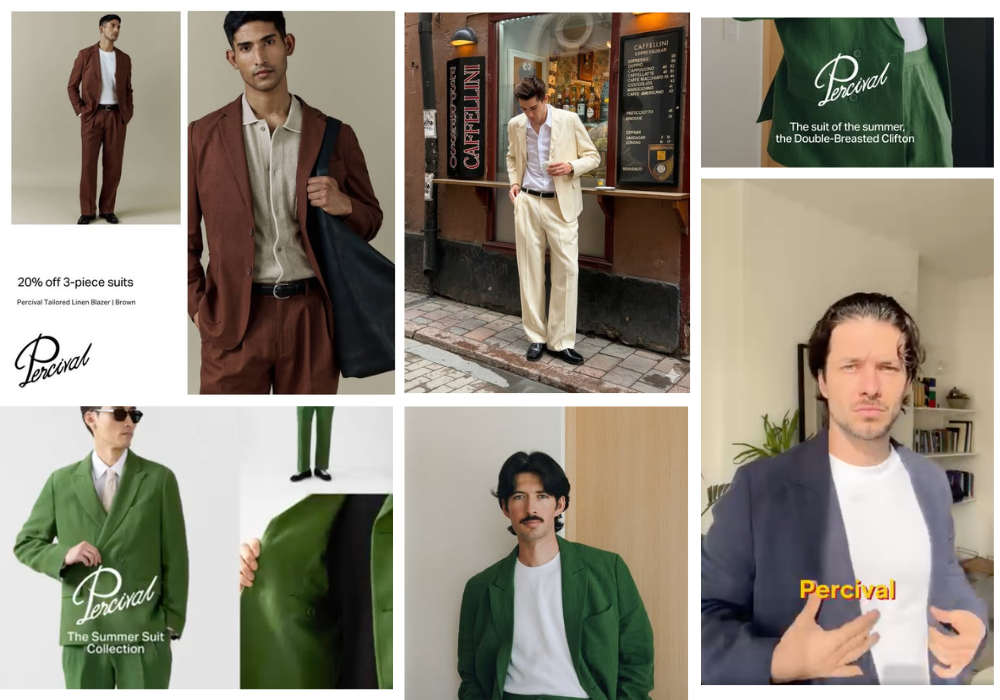
Alongside those, they’re also running more practical, utility-led creative. One video focuses entirely on how to style the suit, helping customers visualise how it could fit into different occasions or wardrobes.
Then there’s a completely different layer of content that’s more creator-led and native to the platform. One image feels deliberately low-fi and influencer-style, like it was casually shot on an iPhone for Instagram. Another video is a guy trying on the suit after buying it for a wedding, speaking directly to camera in a way that feels much closer to personal content than traditional advertising.
What Percival are doing well here is creating multiple different ‘entry points’ into the same product. But none of it feels disconnected from the overall Percival identity. The variation is intentional rather than random.
That’s the sweet spot with creative diversity: multiple creative approaches working together inside one recognisable brand world.
Passenger: Building a cohesive creative world around summer
Passenger are another brand doing a strong job of balancing creative diversity with a consistent campaign identity.
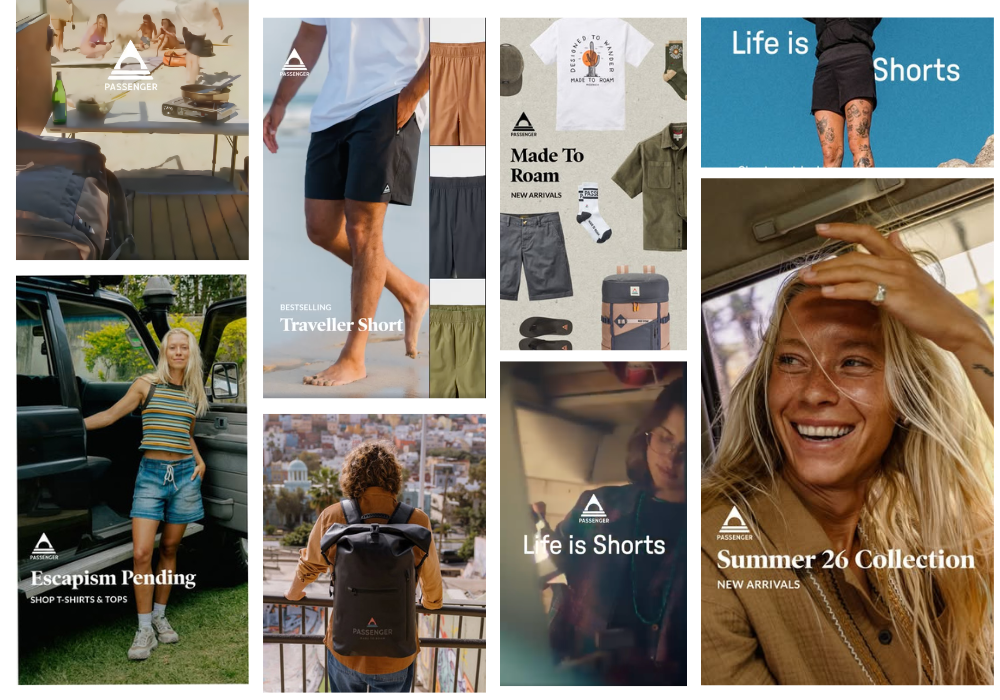
At the top of the funnel, they’re running highly atmospheric brand campaign videos that feel closer to the trailer for an sun-drenched indie roadtrip movie than traditional ecommerce advertising. These aren’t aggressively product-focused ads, but built around mood, feeling, and aspiration: road trips, coastlines, sun, movement, adventure, and the outdoors.
What’s clever is how Passenger then layers more commercial messaging into that same campaign ecosystem.
A step down the funnel, we have beautifully stylised shots that carry the same emotional tone. Models with sun-bleached and sea-salt textured hair, tanned skin, and natural outdoor settings all reinforce the same core feeling of freedom and exploration. The products are present, but the emotional world around them is doing much of the work.
Then underneath that, they’re running more overt product-focused ads clearly showcasing specific shorts and summer products. These creatives are more recognisably sales-driven.
They’re not relying on one single creative format to carry the campaign. They’re building a layered creative system where emotional storytelling, lifestyle imagery, campaign messaging, and direct product advertising all work together.
(💡 By the way, Passenger are also a Dash customer. Check out how they’re using Dash to manage the distribution of thousands of product shots across multiple platforms.)
When onboarding a performance marketing agency makes sense
It’s no surprise that performance marketing agencies are a key player in the growth of DTC brands. Because eventually, many internal teams hit capacity.
For many brands, agencies become most valuable once spend reaches a point where creative fatigue starts meaningfully impacting performance. That’s often when internal teams struggle to sustain the volume and testing cadence required.
The best agencies today aren’t simply producing prettier ads. They’re helping brands build scalable systems for creative iteration and learning.
Vervaunt are a good example of this. It’s clear that they’re experts on the relationship between creative operations, media buying, and ecommerce growth. The strongest partners, like Vervaunt, will help your brand think systematically about creative velocity, testing structures, and sustainable experimentation.
So if creative diversity is the step-up for scaling brands, onboarding a high-performing agency is the next level from that.
The hidden drag that will kill your creative strategy
Producing more creative sounds exciting. Managing it is much harder.
As brands scale Meta activity, creative libraries become chaotic incredibly quickly. Teams suddenly end up juggling raw creator footage, exports, revised edits, feedback rounds, multiple iterations of the same hook.
At some point, almost every growing brand starts asking the same questions:
- Which version actually performed best?
- Can I see all the ads that promoted this particular SKU?
- Did we already test this hook?
- Who has the raw files?
- Which creator made this ad?
- Where’s the 9:16 export?
Without proper systems, creative production slows under its own weight.
Ironically, many brands reach a stage where they could scale creative output further but operational mess becomes the limiting factor. Those that are succeeding with creative diversity are building repeatable systems around creative production.
And the beating heart at the centre of this system? A method to make creative easy to find and reuse.
Because great creative shouldn’t disappear after one campaign.
- A strong hook can be repurposed.
- A winning testimonial can be re-edited.
- Creator footage can become multiple ads.
That only works if teams can actually retrieve and organise assets efficiently. This is exactly why creative operations tools like Dash become increasingly important as brands scale.
Once creative libraries grow into hundreds or thousands of assets, organisation stops being a ‘nice-to-have’ and becomes part of performance itself. The faster teams can search, retrieve, reuse, and repurpose assets, the faster they can iterate.
Brands that treat creative as a system rather than a campaign deliverable are the ones that will get ahead. So, ready to transform your creative operations? Take out a no-strings Dash free trial and get to work.

Barney is the Marketing Lead for Dash. He writes about small business marketing strategies and how DTC brands can boost sales.