
If your Meta ads are underperforming, the instinct is to make more of them. A new brief, a fresh visual direction and another round of creative. Surely something will land.
But in most of the accounts we audit, that's exactly the wrong move.
More creative doesn't fix a broken account structure. It just spreads your budget thinner, starves your ads of the data they need to learn, and makes it harder to know what's actually working. You end up in a cycle of producing more, seeing less and then producing more again.
The fix is almost never what you're creating. It's how you're reading what you've already got.
I'm Jerónimo 👋 the founder of Synced Graphics, a creative production studio that has delivered over 2,000 visual assets for CPG and DTC brands including Hershey's, Reese's, Glad, and Monaco Cocktails.
In this article, I'll walk you through:
- How to audit your account before briefing anything new
- Why more creative is not always the right answer the wrong answer
- What happens to performance when you stop producing and start reading your metrics
Let's get into it 👇
Why is your Meta account underperforming?
To understand why so many Meta accounts end underperforming, it helps to understand how we got here.
Not long ago, creative production was expensive. Every decision was deliberate and you had to budget for six ad variations. You had to think hard about those six, meaning your constraints forced you to focus.
Then 3D and AI changed the economics. A product modelled once can generate unlimited angles, lighting setups, and compositions. Pair that with AI-generated backgrounds and you can turn around a full set of ad-ready visuals in hours, without a photoshoot. The production bottleneck is gone.
Two years ago, that speed was a genuine edge. Now these tools are accessible to almost anyone — and with them came a flawed assumption: that more creative, produced faster, will always lead to better performance.
The temptation is to generate everything and let the algorithm decide. In practice, this creates a specific problem for brands with smaller budgets. Meta needs roughly $50–100/day per ad to exit the learning phase properly. A brand splitting $100/day across 10 ads isn't testing 10 things — it's starving all 10 of them simultaneously.
The result looks like underperforming creative. So brands produce more creative and the cycle repeats.
At Synced, we fell into this trap ourselves. The assets looked great — but we had no idea whether they were working. Neither did our clients. When performance dipped, the answer was always the same: produce more.
So we changed what happens before production. Instead of "what should we make," we now start with "what does the data already say?"
This is where auditing comes in.
How to audit your Meta ad account
Auditing means pulling 90 days of performance data and cross-referencing cost per mile (CPM) trends, click quality, frequency, and conversion patterns — broken down by format, hook type, and audience stage. The goal is to find where the signal breaks down. Where an ad looks healthy on one metric but is quietly failing on another. That's where the actual constraint lives.
Once you find it, you know exactly what to produce — and often, how little you actually need to produce.
Here's how to do it yourself.
1. Check where your budget is actually going
Pull your active ads and check how much daily spend each one is actually getting. If you're running 12 ads on a small budget, none of them are learning. Consolidate down to your two or three strongest variations and give those the budget to actually prove themselves.
2. Check if your visual style is actually converting
Don't assume polished means effective. Casual-looking product imagery consistently outperforms high-production studio work on cost per acquisition across many CPG categories. Check what style is actually driving purchases in your account before commissioning anything new.
3. Cross-reference CTR with purchase data
A high click-through rate (CTR )is not a win if it isn't converting to purchases. An ad attracting curiosity clicks can look like your best performer while quietly draining budget. Always check both numbers together.
4. Check if you're defaulting to video when static would work better
In some accounts, we found that static creative delivers a significant CPA advantage over video. For product-driven purchases, buyers want to clearly see what they're buying. Motion can actually work against that.
5. Look for underfunded ads with strong signals
Sort by CPA and look for any ad that has a strong result but low total spend. This is often where the answer already lives — it just hasn't been given the budget to prove itself.
6. Track the right metrics together
Once you've consolidated and given your ads room to breathe, resist the urge to jump straight to conclusions. Focus on shifts across the whole account rather than individual ad swings, and always read metrics in combination rather than in isolation.
- Start with CPM trends — if the cost to reach your audience is rising, it can signal audience fatigue before your CTR even moves. Then cross-reference CTR with purchase rate, because a high click-through rate means nothing if those clicks aren't converting. An ad that looks like your best performer can quietly be your biggest budget drain.
- Keep an eye on frequency too. If the same person is seeing your ad too often on a small audience, fatigue sets in fast. And when you're breaking down CPA, do it by format — static, video, and carousel separately. The format split often tells you more than the overall account number.
- Finally, check whether your ads are actually exiting the learning phase. If they're stuck, budget consolidation is almost always the fix — not a new brief.
Give each change enough time and enough spend before drawing conclusions. Rushing to the next round of creative before you've properly read the result is exactly how the cycle starts again.
Common mistakes to avoid
Treating new creative as the default fix
When performance dips, the instinct is to produce more. But new creative layered on top of a broken account structure won't fix the underlying problem. The audit has to come first — otherwise you're just pouring budget into a setup that can't learn from it.
Ignoring category-level patterns
Across multiple brands in the same category, the same fatigue timelines, format preferences, and audience response curves keep showing up. If you're only looking at your own account in isolation, you're missing half the picture. Paying attention to category patterns makes every future decision sharper.
Conflating activity with progress
Running 20 ads feels like momentum. It often isn't. One ad with $80/day will outlearn ten ads with $8/day every single time. More creative isn't more data — it's less, spread thinner.
To see how this plays out in a real account, here's a recent example from one of our clients.
Case study: How a specialty coffee brand cut CPA by 38%
The problem
A specialty coffee brand came to us with 12 ads running on roughly $10/day total — less than a dollar per ad, per day. Performance was declining, and every few weeks they'd brief a new round of creative trying to fix it. Each round came with a fresh visual direction and real production effort.
Nothing was moving.
They were convinced the problem was the creative they were producing.
What the audit found
After pulling 90 days of performance data, the answer was already sitting in their account. A scrappy, casual image of the product being added to a cart—something they'd included almost as an afterthought—had a $1.68 cost per acquisition. The polished packaging shot they'd built the account around was sitting at $7.04.
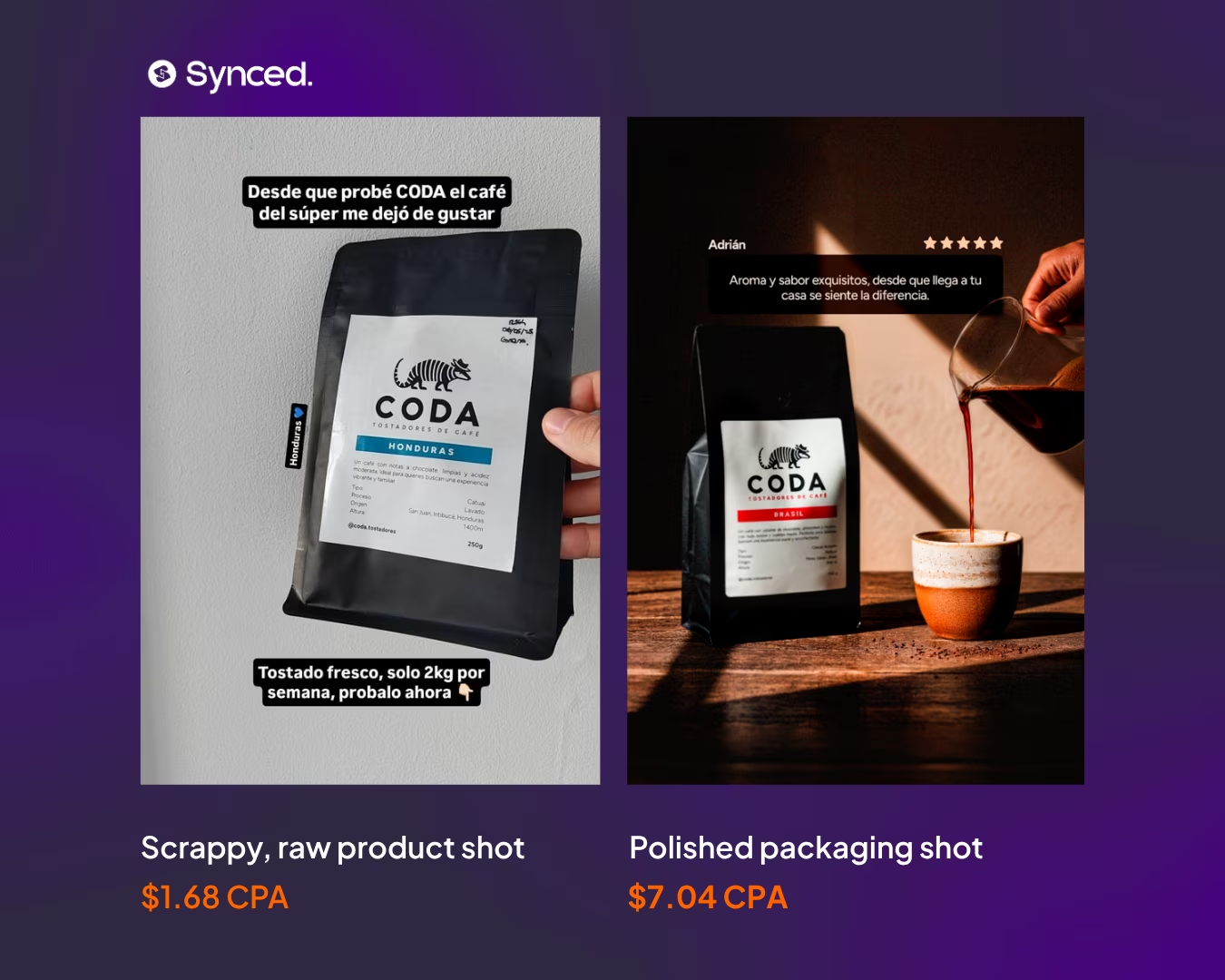
The $1.68 ad had never been given enough budget to prove itself. They'd been producing round after round of new creative to solve a problem that was actually an account structure problem.
What we did
We consolidated the account from 12 active ads down to 2 and gave the $1.68 ad real budget for the first time. The polished shot was paused.
The audit gave us a clear creative direction: raw, product-forward, low-friction imagery outperforms polished studio work in their category. This wasn’t a gut feeling, it was a direction backed by their own data and cross-referenced against patterns we'd seen across other specialty coffee brands in our database.
From there, we used 3D + AI production to build deliberate iterations of what the account had already validated. What would previously have taken three weeks and at least $2k — coordinating a photographer, agency, and designer — was turned around in days from a single 3D product file. Different angles, different contexts, same underlying signal. Every asset had a reason behind it, not just a visual direction.
The results
The account exited the learning phase for the first time in months. Early results show a ~38% improvement in CPA across active ads.
The alternative would have been another production round: new brief, new assets, weeks of back and forth, another $800–1,500 in production costs, all poured into the same diluted structure that couldn't learn from any of it.
The audit isn't just about finding what to fix. It tells you what to build next — and just as importantly, what not to build. That's where the process becomes a repeatable system rather than a one-off fix.
3 things worth doing right now
If you take nothing else from this article, start here.
1. Audit before you produce
Before briefing your next round of creative, look at what's already running. What's actually spending? What's stuck in the learning phase? What has real data behind it? You might already have your best ad. It might just be underfunded.
2. Build a simple creative CRM
Start tagging your ads consistently: format (static, video, carousel), hook type (problem-led, product-led, social proof), visual style (studio, lifestyle, UGC). Over time, this history tells you what actually works for your product, your audience, and your category — and makes every new brief smarter. Month six looks nothing like month one.
3. Run fewer things with more behind each one
Consolidating is usually the highest-leverage move in an underperforming account. One ad with $80/day will outlearn ten ads with $8/day every time. Pick your strongest variations, give them room to breathe, and measure properly before making your next move.
Once you've made those changes, here's what to watch to know whether they're working.
Find out what your Meta account is actually telling you
We've recently finished analysing over 2,500 ads across RTD Cocktails, Supplements, Specialty Coffee, Snacks, Skincare, and Better-for-You Soda. Each audit adds to that base. The patterns get sharper. The action plans get more specific.
If you'd like to learn more, you can follow me on LinkedIn or visit the Synced Graphics website.
And if you’re currently stuck in the content chaos of Google Drive and Dropbox, it might be time to level-up your tech stack. Dash’s digital asset management software is built for brands who need a way to organise, manage and share their creative.
👉 Learn more about ecommerce digital asset management
.png)
Jeronimo went from being a technical 3D artist, to helping DTC brands sell more products with data-backed ads. He founded Synced Graphics to make the process smarter - analyzing what actually works before jumping into production