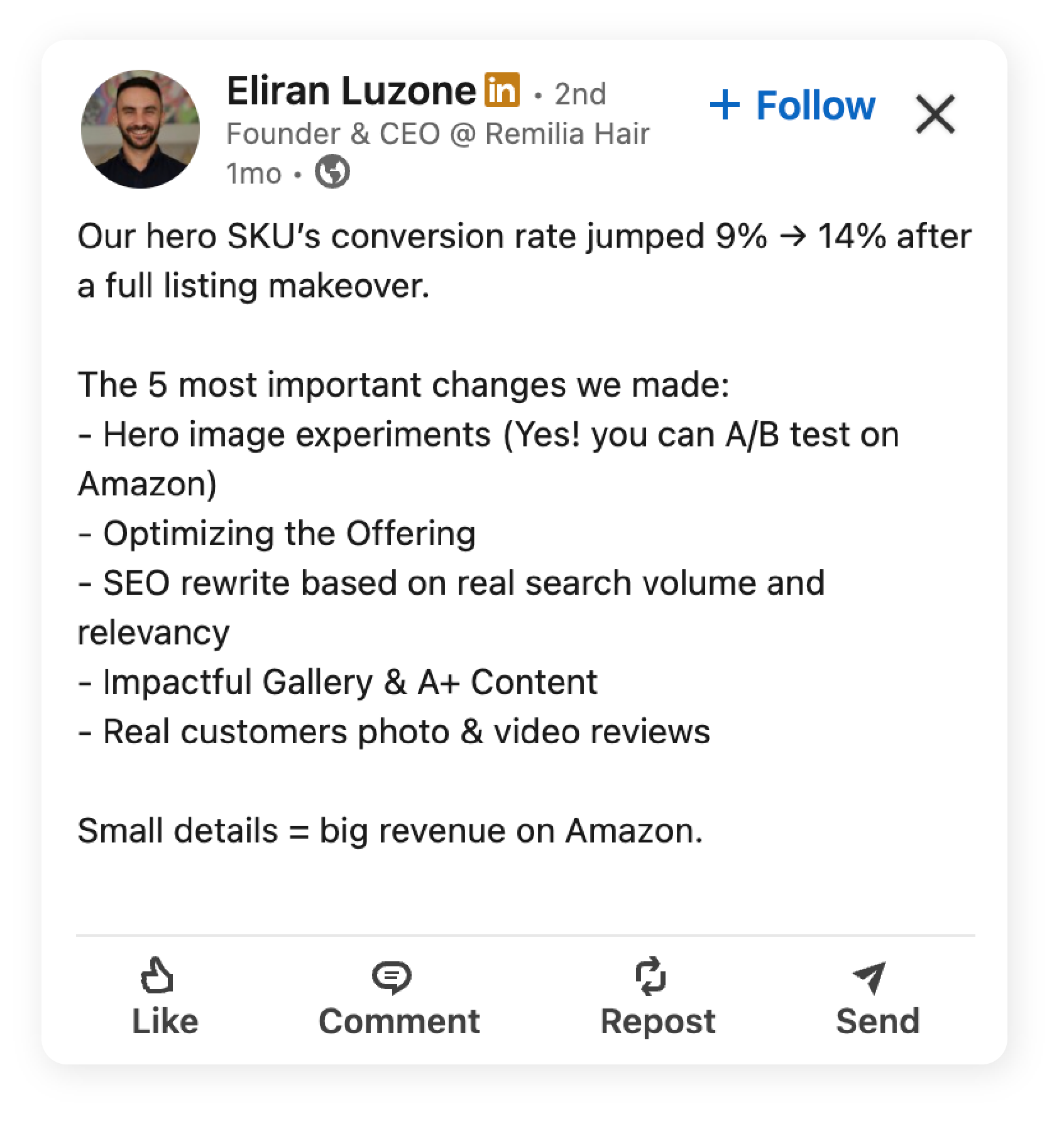
A few months ago, we refreshed and optimized our Amazon listing for our hero product…and it paid off.
Our conversion rate jumped from 9% to 14%.
I’m sharing this because Amazon doesn’t have to be just another marketplace you feel obliged to list on. When you treat it like a real growth channel, and optimise your listings properly, it can drive meaningful revenue.
I’m Eliran 👋, the CEO of a Remilia Hair, a hair care brand that launched on Amazon. In this article I’ll offer tips on Amazon listing optimisation to help you build trust (and $$$) on the platform.
Why we picked Amazon for Remelia Hair's early growth stage
Remilia Hair was launched in 2018 with our hero product, The Cosmocap Daily Hair Serum.
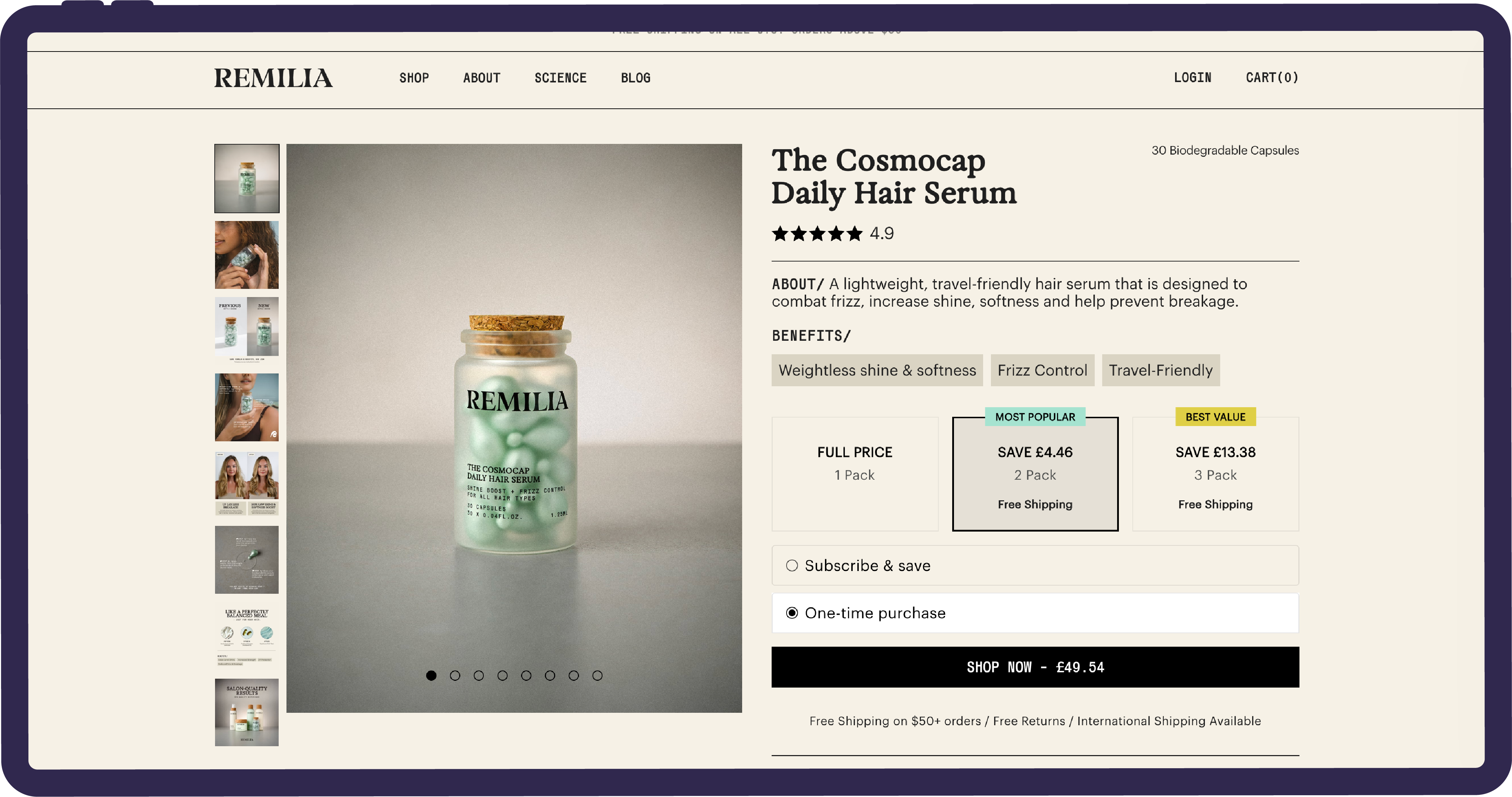
Our brand is inspired by both my personal journey with hair loss and my background in beauty product development. Our goal has always been to build a global brand of everyday essentials for healthy, beautiful hair, blending performance, design, and sustainability.
In the early days we had very limited funding and resources. Amazon was the most accessible and cost-effective way for us to launch, be discovered, and convert customers quickly.
It allowed us to test the product in a real market, build demand, and grow without the heavy investment required for traditional retail or large marketing budgets. Over time, Amazon became an important foundation for the brand’s growth, simply because it met us where we were as a young company.
Why we onboarded an Amazon agency
Remilia is intentionally built as a lean, highly specialized team. I’ve always believed in staying close to the business and understanding every channel deeply, especially in the early years. I personally managed our Amazon presence from launch, from listings to operations, which helped shape how the brand shows up and performs on the platform from an organic Amazon ranking perspective.
As the brand grew, we onboarded a dedicated Amazon agency that now manages our listings and performance day to day, while I stay closely involved in overall brand and product strategy. This structure allows us to stay agile while working with experts in each area as we scale.
6 Amazon listing upgrades you can do now to improve ranking and conversions
Trust me when I say—optimising your Amazon listing works. After a full listing makeover on our hero SKU, The Cosmocap, our conversion rate jumped from 9% to 14%.
The biggest changes we made included:
- Testing hero images
- Optimising the overall offering
- Rewriting our SEO based on real search volume and relevancy
- Upgrading our gallery and A+ content
- Adding real customer photo and video reviews.
Let’s get into the upgrades you can make right now.
1. Make images a top priority on your Amazon product page
From the beginning, our brand stood out because of its visual identity and unique design, and that was very intentional. I studied design myself and never wanted to compromise on how the products look, especially in a category like beauty where aesthetics and emotion play such a big role in purchase decisions.
We need a lot of product imagery, as you can imagine. To manage this, we organize dedicated photoshoot days periodically — usually around new product launches — and also work on an ongoing basis with content creators and photographers. All of the assets we produce are used across our key channels including Amazon product pages, our website, and social media. Everything is created with multi-channel use in mind.
My advice would be to treat your Amazon visuals as seriously as you would a campaign shoot or a website launch. Find strong content creators or photographers who understand your niche and your customer, and invest in that partnership. It’s absolutely worth it. In fact, take a look at our Amazon page before and after optimisation.
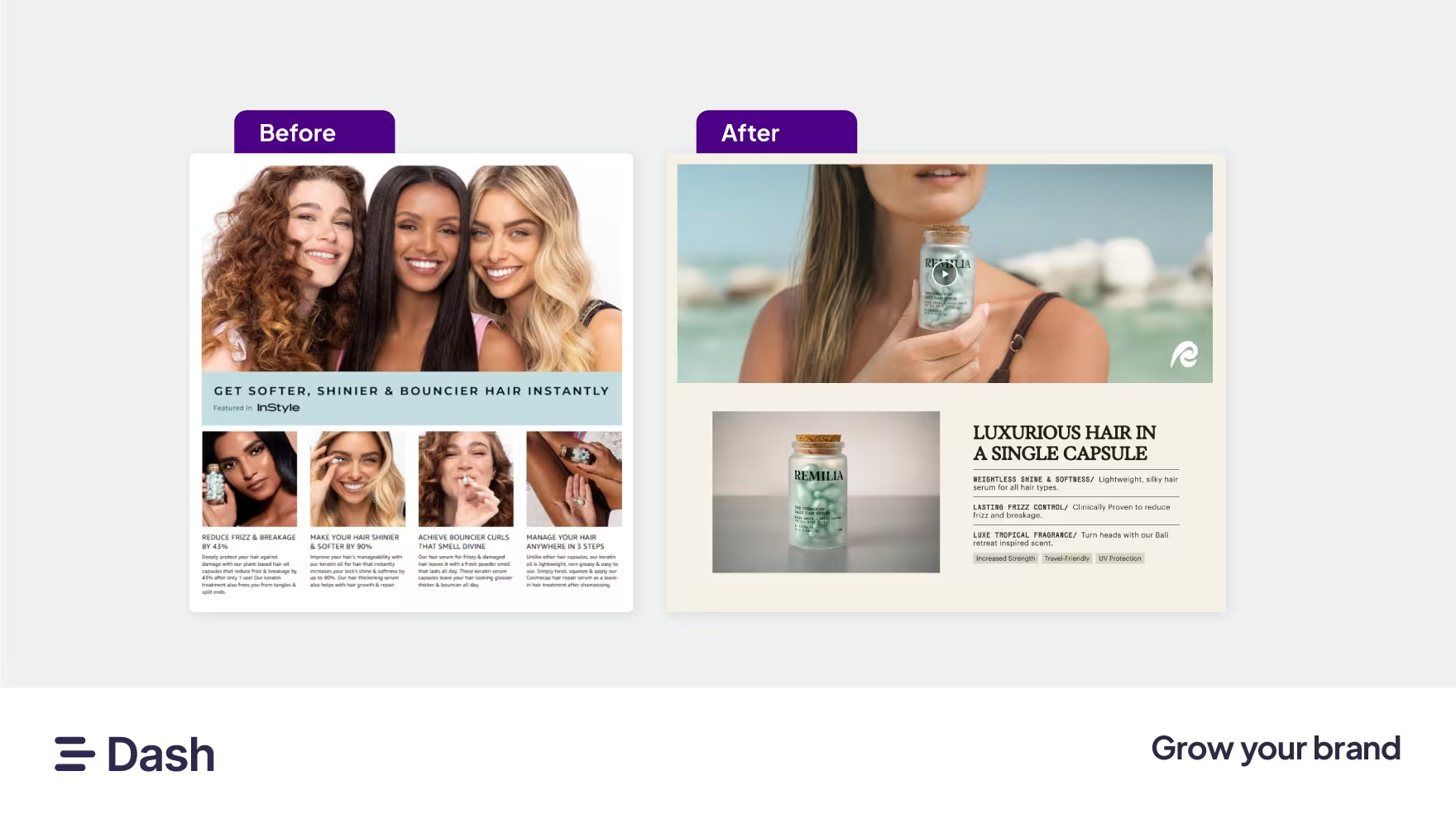
As you can see, the new imagery and placement is cleaner, the copy has been stripped back and the imagery has been paired back to focus more on the product itself.
2. Price competitively within your Amazon category
When you don’t yet have strong brand awareness, price plays a huge role in conversion. If you’re positioned significantly higher than similar products, it becomes very hard to win, no matter how good your content is or how well your Amazon listing is optimised.
So make sure to benchmark your price against direct competitors with similar formats and benefits, and make sure your value is clearly justified if you’re premium. Use promotions or bundles strategically to stay competitive without permanently discounting your brand.
3. Focus on reviews and social proof for Amazon
Reviews are one of the strongest trust signals on Amazon and a key factor in organic ranking, especially for newer or emerging brands.
How do you encourage customers to post Amazon reviews? Honestly, if they genuinely love the product, they’re far more likely to leave authentic reviews. But you can point them towards leaving reviews on Amazon in your marketing comms. This will help build credibility and long-term momentum on the platform.
4. Write clear, benefit-driven product information (copy, structure, and Amazon SEO)
Once someone lands on your page, they need to understand very quickly what the product does and why it’s right for them.
Your copy should balance search visibility (Amazon SEO) with simple, human language. So do some research by looking at how people actually search on the platform. Use Amazon autocomplete suggestions, check out competitor listings that rank well, and pull from phrases customers use in reviews and Q&As.
And when it comes to writing, make sure your titles and bullet points lead with benefits, not just features, and make sure key information like who it’s for, how to use it, and what results to expect is easy to scan.
Here’s how we presented product copy, before and after our page optimization.
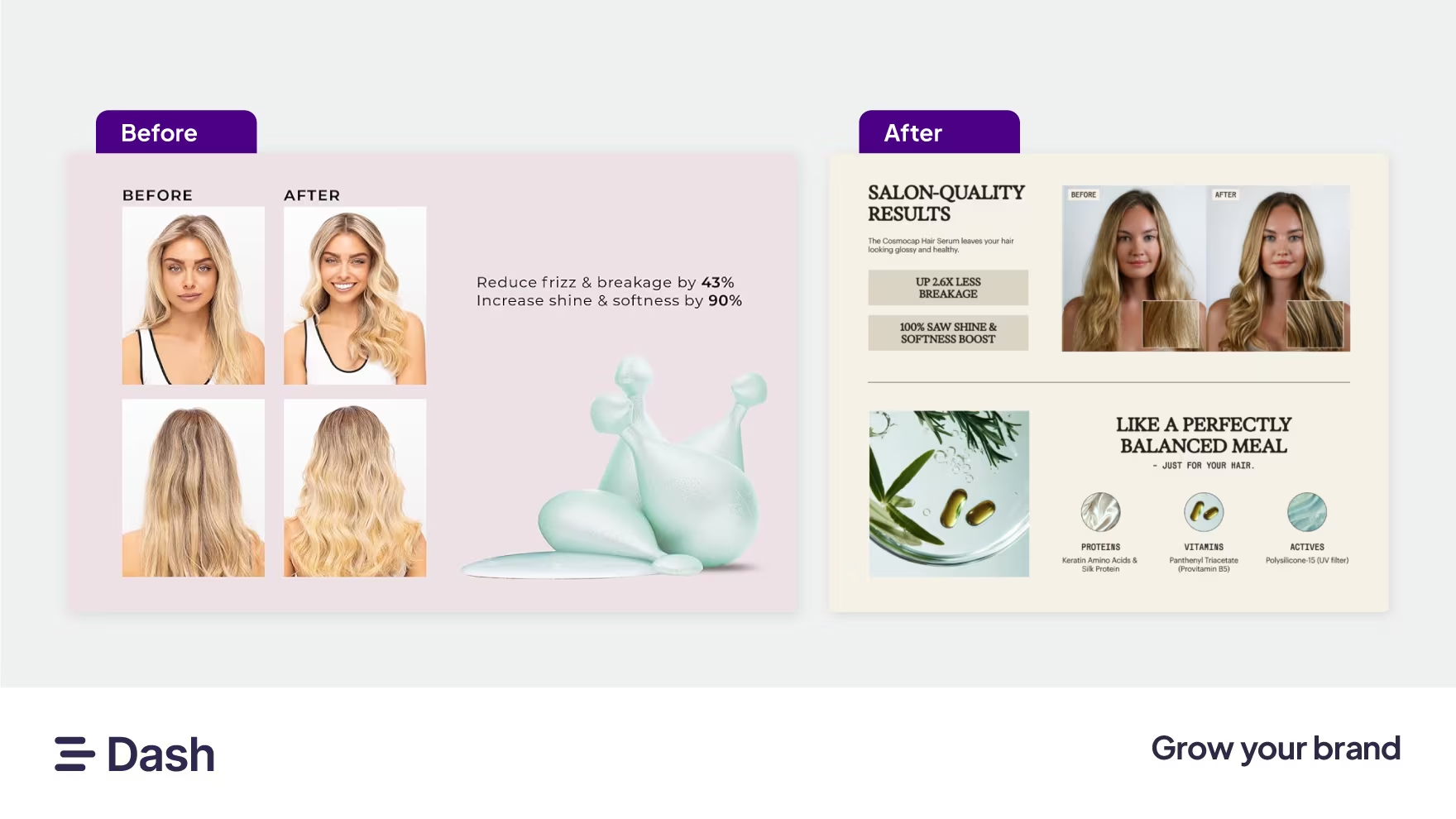
Here, we lead with benefits like ‘salon-quality results’ and ‘perfectly balanced meal.’ We pay close attention to close-ups of the model and ingredients used. And include real stats like ‘100% saw shine and softness boost.’
5. Use creator insights to refine your Amazon listing over time
Pay attention to how influencers and affiliates talk about your product — what they highlight, the questions their audiences ask, and which benefits resonate most. This feedback is a valuable signal for what actually matters to customers.
Use feedback to refine your Amazon content over time to improve relevance and conversion. That could be adjusting your messaging, emphasizing certain benefits more clearly, or updating visuals to reflect how people really use the product.
6. Build strategies off-Amazon
For us, off-Amazon content is actually the main driver of our Amazon growth. In the early days, paid ads were necessary to build momentum, but over time we found that external traffic and brand-building efforts have a much more sustainable impact on our listings than relying heavily on Amazon ads alone.
So now, we focus a lot on PR and influencer content to bring in high-quality, intent-driven traffic. The best part is that Amazon tends to reward that with stronger organic ranking and visibility across Amazon search results. When customers arrive already educated and excited about the product, conversion is higher, which reinforces performance on the platform.
Today, we spend significantly more on PR and influencers than we do on Amazon PPC which is roughly three times more.
Use Amazon as your launch pad and watch your store grow
In the early years, Amazon represented nearly 80% of our revenue. Today, it’s closer to 40%, which reflects how the business has diversified over time. Amazon comes with its challenges, but it’s also a marketplace you can’t ignore in today’s beauty landscape. For us, it’s been an important foundation while we’ve built out other channels and retail partnerships.
For more Amazon and brand growth tips, make sure to follow me over on LinkedIn. 👈
And check out more tips and strategies for your ecommerce channels:
- How to optimise your Google shopping feed
- How to expand your brand into retail stores
- 21 ecommerce marketing strategies

Eliran is the CEO of Remilia Hair. He has a strong background in beauty product development and has built his hair care brand from the ground up. Follow Eliran on LinkedIn for tips on brand growth, Amazon optimisation and how to generate revenue from your products.